

5.4. Environmental#
Environmental sensors allow systems to measure and respond to the surrounding atmosphere. They detect physical and chemical properties such as temperature, humidity, pressure, and the presence of particles or gases.
5.4.1. Temperature Sensors#
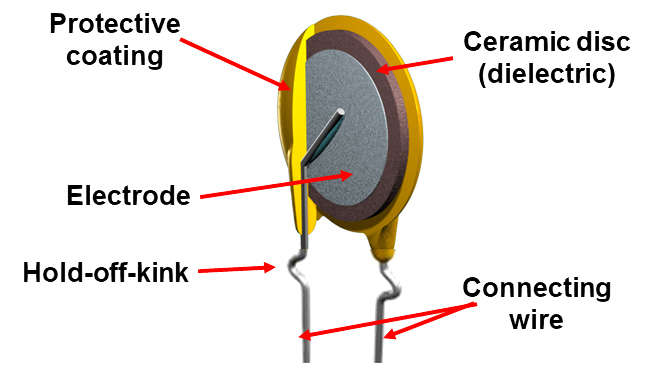
Thermistors are temperature-sensitive resistors whose resistance changes predictably with temperature. Negative Temperature Coefficient (NTC) thermistors decrease resistance as temperature rises, while Positive Temperature Coefficient (PTC) thermistors increase resistance. They are inexpensive, simple to use, and suitable for measuring relative temperature changes. However, they require calibration and compensation for precise absolute measurements.
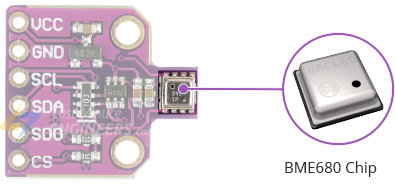
Digital IC temperature sensors integrate a temperature-sensing element with on-chip signal processing and a digital communication interface. Many of these devices, such as the LM75, DS18B20, or Bosch’s BME680, use a silicon bandgap sensor principle. A bandgap sensor relies on the predictable change in voltage across a semiconductor junction as temperature varies. This signal is converted to a digital output, providing a temperature measurement.
5.4.2. Humidity Sensors#
Humidity sensors measure the amount of water vapor in the air, usually expressed as relative humidity (RH). The most common type is the capacitive humidity sensor, where a hygroscopic dielectric material absorbs moisture and changes capacitance in proportion to humidity.
5.4.3. Air-Pressure Sensors#
Air-pressure sensors, often based on MEMS (Micro-Electro-Mechanical Systems) technology, measure barometric pressure by detecting deflections in a tiny diaphragm. These sensors provide altitude estimates and weather-related data by tracking atmospheric pressure changes.
Applications include drones (for altitude control), smartphones (for indoor navigation and stair detection), and weather monitoring stations. Air-pressure sensors are generally compact, accurate, and capable of detecting very small pressure changes.
5.4.4. Particulate-Matter Sensors#
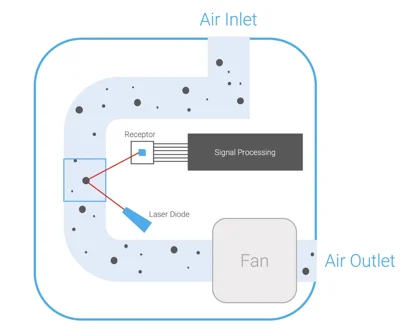
Particulate-matter (PM) sensors detect tiny solid or liquid particles suspended in air, such as dust, pollen, smoke, or pollution. The most common method is optical scattering, where an LED light beam passes through air and a photodetector measures the intensity of light scattered by particles. These sensors classify particle sizes (such as PM2.5 or PM10) and are widely used in air purifiers, environmental monitoring, and health-safety devices.
5.4.5. Gas and VOC Sensors#
Gas sensors detect specific gases or groups of gases, while VOC (Volatile Organic Compound) sensors measure broader categories of airborne chemicals. Technologies vary:
Electrochemical sensors detect gases like CO or NO₂ through chemical reactions at an electrode.
Metal-oxide semiconductor (MOS) sensors change resistance when exposed to gases such as methane, ammonia, or alcohol.
Photoionization detectors (PIDs) measure VOCs by ionizing molecules with UV light.
These sensors are used safety systems (carbon monoxide alarms), environmental monitoring, and industrial applications (gas leak detection).