

5.12. Group By#
It can often be useful to group data by a particular attribute. For example, consider the following table.
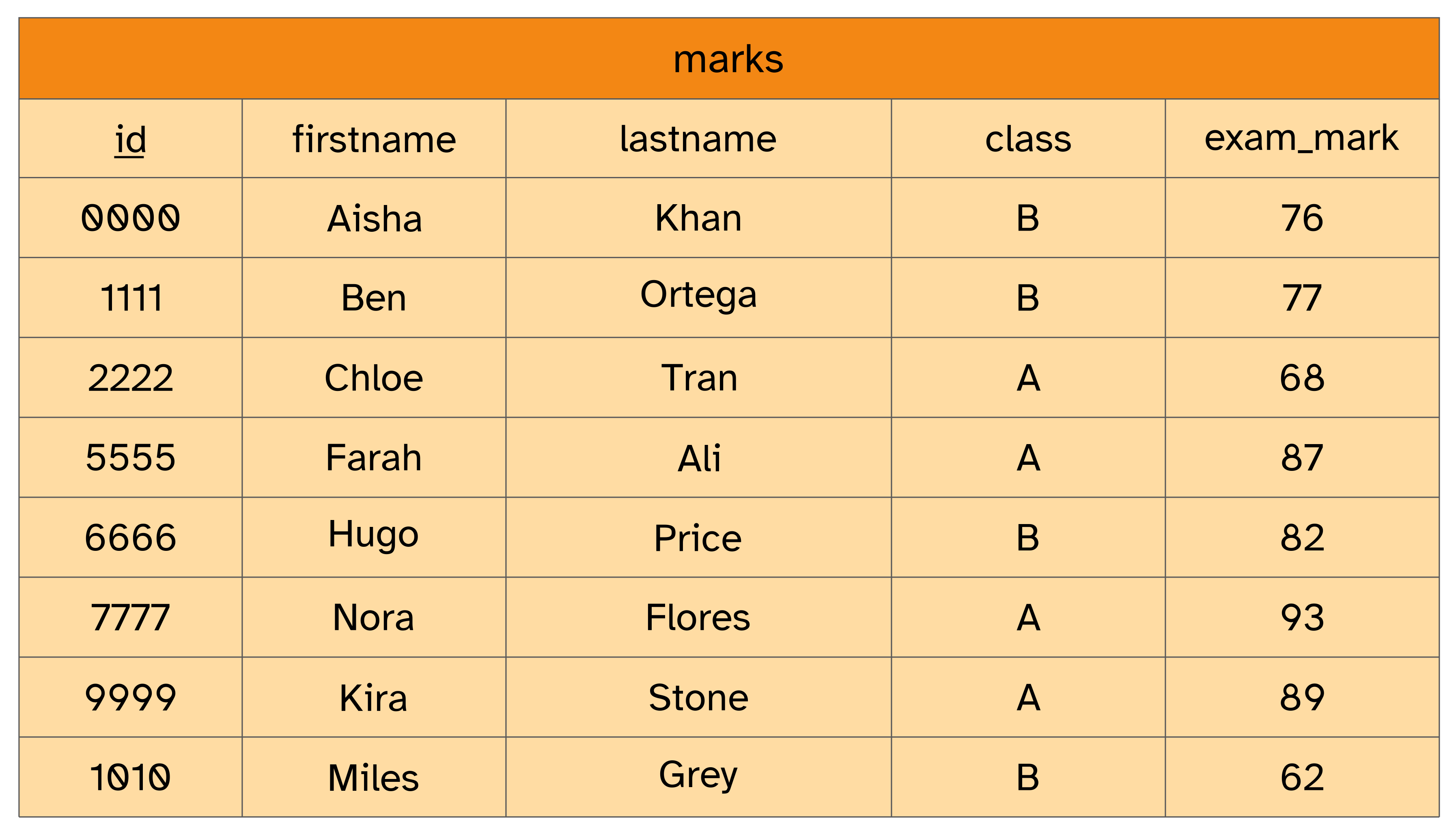
Let’s suppose we want to see how students performed on the exam BY class.
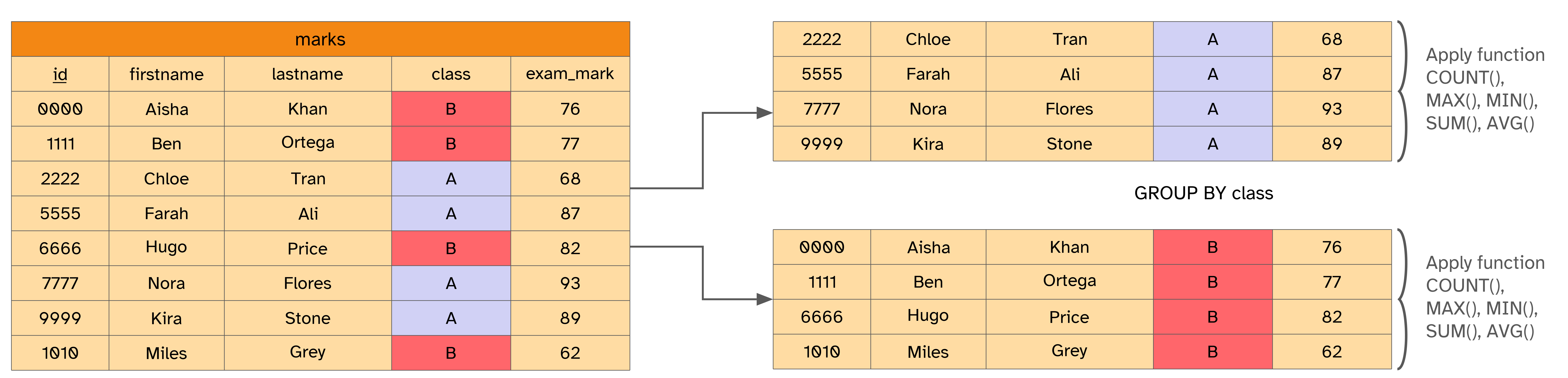
In this case, there are two classes, class A and class B. What we can do, is
GROUP BY class. The structure of a GROUP BY statement:
GROUP BY attribute;
The GROUP BY clause goes after a WHERE clause.
We then need to provide a function that summarises information about each group. The functions we can use are:
COUNT()MAX()MIN()SUM()AVG()
This whole process can be summarised by the figure below.
These functions go in the SELECT statement. Here is an example.
SELECT AVG(exam_mark), class
FROM marks
GROUP BY class