

5.1. Overview#
5.1.1. What is a Database?#
A database stores data relating to a particular subject. For example, you can have a database storing all the information on staff in a company.
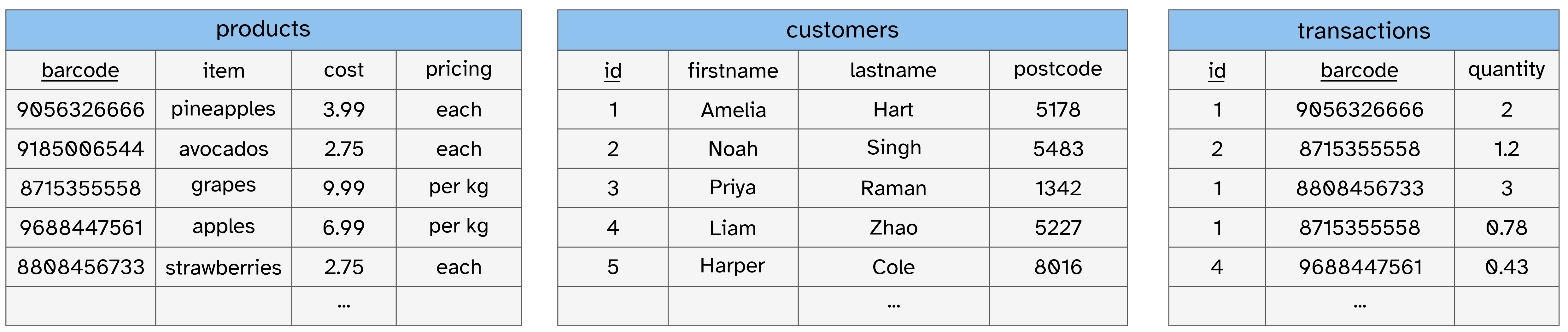
Databases store data as a collection of relations (tables). There are usually relationships between these relations in the database.
Below is an example of a shopping database.
5.1.2. Querying a Database#
To extract information from a database we construct a query.
A query is an instruction that tells the database what to do. For example, we can get a database to display a table, or we can tell the database to add new data.
To give our instructions to the database in a way it can understand, we need to formulate our query with a particular structure. For this, we will be using SQL (Structured Query Language). Like Python, SQL has its own rules for how you should write commands.
Here is an example of a query that displays the customers table.
SELECT *
FROM customers;
5.1.3. Glossary#
- Database#
A database stores data relating to a particular subject, often organised as related tables.
- Table#
A table is a relation in a database that stores data in rows and columns.
- Query#
A query is an instruction that tells a database what to do, such as display, add, update, or delete data.
- SQL#
SQL, or Structured Query Language, is a language used to write structured commands for working with databases.